Snow Removal in Cambridge, Ontario
Lot plowing and salting for the industrial parks and plazas, seasonal driveway contracts on the hills of Galt, Preston and Hespeler, and sidewalk service that meets Cambridge's 36-hour rule. Seasonal contracts are being booked now.
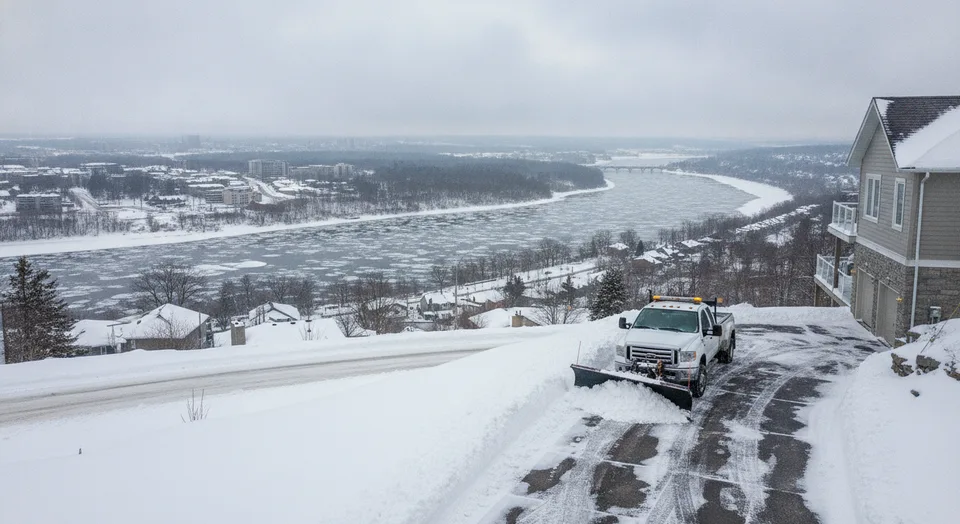
Cambridge's industrial parks are a large part of the winter trade here, and the work is shaped by them. The parks off Franklin Boulevard, Boxwood Drive, Hespeler Road and Eagle Street are full of plants, warehouses and distribution units whose lots have to be open for the shift change and the first truck, and whose owners carry the liability for every employee walking from a car to a door. That is the commercial side. The residential side is topography. Galt, Preston and Hespeler were built on the slopes above the Grand and the Speed, and a driveway on a street like those climbing out of downtown Galt or down toward the river in Preston is a different job from a flat one: the snow wants to slide, the ice forms on the grade, and a half-cleared sloped drive is worse than an uncleared one. The City's sidewalk rule is 36 hours after the snowfall ends, more generous than Kitchener's or Waterloo's, but the City also says its officers monitor sidewalks proactively rather than waiting for a complaint. None of this comes with a promise of a clear lot or drive by a fixed hour. When a storm is still going, nobody can honestly make one.
Snow Removal Work We Take On in Cambridge
Industrial and plaza lot plowing and salting, seasonal driveway contracts for sloped and flat residential lots, sidewalk service for property managers, salting and ice control, and per-visit clearing.

Industrial & Plaza Lot Plowing
Plowing, dock and lane clearing, entrance hand work and salting for industrial units, warehouses and plazas, with a written scope, a stacking plan and a visit log.
Learn more →

Seasonal Driveway Contracts
One fixed price for the winter for the driveway, walk and steps, including the City plow windrow, with sloped drives cleared in the right direction and ice-controlled where the meltwater refreezes.
Learn more →
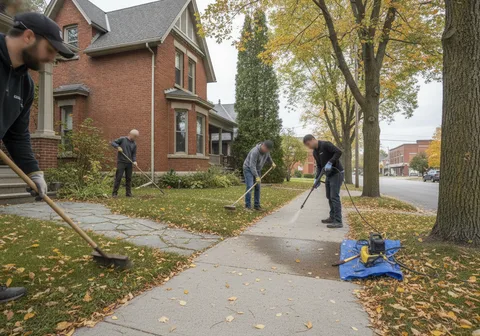
Sidewalk Service for Property Managers
Frontage sidewalks at rental houses, small apartment buildings and downtown storefronts cleared after each snowfall and ice-controlled between storms, several addresses on one agreement with a visit record per property.
Learn more →
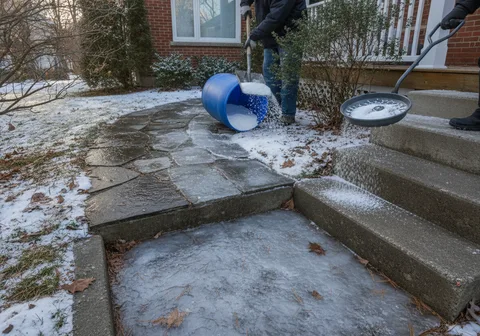
Salting & Ice Control
Ice control that follows conditions: salt in the range where it works and at a stated rate, sand or a treated product on the cold days, and attention to the foot of every slope where the meltwater refreezes.
Learn more →
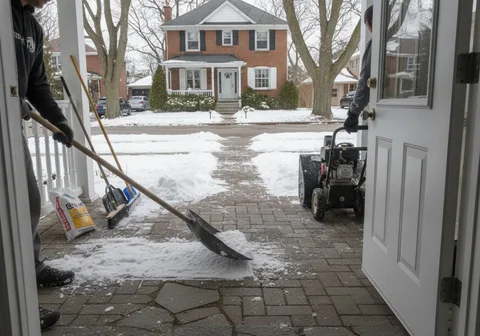
Per-Visit & On-Call Clearing
One storm, one price, for households that usually manage on their own and want help for the big one, a stretch away, or the windrow the City plow left.
Learn more →
Snow in Cambridge: 36 Hours, Steep Streets and Protected Water
36 hours, and officers who do not wait for a complaint. Cambridge's rule, stated on its winter maintenance page, is that residents are responsible for clearing snow and ice from the sidewalks around their property within 36 hours of a snowfall ending. That is twelve hours more than Kitchener or Waterloo allow, and it is the figure that applies here, not the one a friend in another city quotes. The enforcement side is less relaxed than the deadline suggests. The City's snow event page says by-law officers respond to complaints and proactively monitor sidewalks for compliance, and the consequence of an uncleared sidewalk after inspection is a summons or the City clearing it and sending a bill. For a property manager with a dozen frontages in Galt, that is a dozen chances a winter to be found out without anyone having to complain. The City clears some sidewalks itself, including those along regional roads, back-lot sidewalks, and curb-faced sidewalks with a boulevard under 0.25 m, but it specifically excludes the Galt, Hespeler and Preston BIA cores from the curb-faced category, so a downtown storefront sidewalk is the owner's job even when it sits right at the curb.
Snow events, the parking ban, and what stays snow-covered. The City declares a snow event when more than 8 cm is forecast, or when crews need to service residential roads for ice. From the start time, parking is prohibited on all streets until the event ends, every previously issued exemption is cancelled, the set fine is $80, and vehicles that interfere with clearing are towed at the owner's expense, not necessarily every car on the street, just the ones in the way. Separately, overnight on-street parking is not permitted from January 1 to March 15 between 2:30 and 6 a.m. without an exemption. Two things on the City's page are worth knowing before signing any contract. First, most residential streets, laneways and courts are not regularly salted, to protect the drinking water, and the City says plainly that most of them will remain snow-covered through much of the winter. Second, residential streets are plowed when accumulation is typically 8 cm or more, after priority routes, with courts and some laneways done by contractors on their own timing. Your driveway can be cleared, the street can stay white for a week, and the City plow can arrive days later and leave a windrow. The contract has to account for all three.
Galt, Preston and the problem with a grade. Cambridge's older neighbourhoods were built on the river valleys, and the streets climbing away from the Grand in Galt and the Speed in Hespeler and Preston are steep enough that the City lists hills and curves among its priority routes. A sloped driveway changes the job. Snow cannot be pushed uphill efficiently, so the direction of clearing and where the pile ends up are decided by the grade rather than by preference. Meltwater runs down the drive and refreezes at the bottom, often right where it meets the sidewalk, so a sloped drive needs ice control at the foot even when the top is bare. A partially cleared slope with a thin layer left on it is more dangerous than a snow-covered one, because tyres and boots find the ice under the dusting. Section 181 of Ontario's Highway Traffic Act prohibits depositing snow on the roadway without written permission, and the City's own page asks residents not to shovel snow back onto the road or over catch basins, which on a hill means the easy option of letting it run down to the street is the illegal one. The stacking plan on a sloped lot is settled on the site visit and marked before the ground freezes.
The industrial parks, and what a lot contract has to say. The lots off Franklin, Boxwood, Eagle Street North, Hespeler Road and the Pinebush corridor run on shifts and truck schedules, and the contract for them is a document before it is a service. It states the trigger depth, whether clearing happens overnight or between shifts, which docks and lanes are cleared first, where snow is stacked so it does not take the trailer turning radius or block the fire route, when stacked snow is hauled off and at whose cost, how entrances and walks are hand-cleared, and how ice is managed between storms. It also states the salt application rate, because an industrial lot is a large paved area draining to the storm system and the Region of Waterloo's guidance on salt is aimed squarely at it. Every visit is logged with date, time, conditions and product, which is what the insurer asks for if someone falls at the shift change. Smaller plazas along Hespeler Road and in the three downtowns get the same scope at a smaller scale.
Why Cambridge is careful with salt. The City limits salt to major roads, intersections and hills to protect the drinking water supply, says its use is restricted in Drinking Water Protection Areas, and reports that monitoring equipment on its spreaders has cut application rates by about 30 per cent. It prefers salt to sand on the routes it does treat, because sand needs roughly four times the volume and creates spring clean-up and catch basin work. The Region of Waterloo's salt management page explains the reason: the Region draws drinking water from groundwater wells, salt soaks into that groundwater and stays there, chloride levels in municipal wells have been rising, and some are near or above the 250 mg/L Ontario Drinking Water Objective. The Region also notes that rock salt does not work below about -10 C and that ice melters sold as environmentally friendly still contain salt. On a private lot or driveway in Cambridge the translation is simple: salt where there is ice and the temperature is in range, at a rate that reaches bare pavement without a residue, sand on the cold weeks, and nothing on a surface that is already clear.
The 36-hour sidewalk rule, the City-cleared sidewalk categories, the January 1 to March 15 overnight parking rule, residential plowing at typically 8 cm, and the City's salt policy are from the City of Cambridge's winter maintenance and snowplowing page; the snow event trigger, the $80 set fine, towing, proactive sidewalk monitoring and the note that residential streets stay snow-covered are from the City's snow event page; the assistance programme details are from the City's Snow Removal Assistance Program page. The City is the authority if anything changes. The roadway rule is section 181 of Ontario's Highway Traffic Act. Groundwater and chloride facts are from the Region of Waterloo's salt management page. Ayr and other North Dumfries Township addresses fall under the township's by-laws rather than Cambridge's.
Frequently Asked Questions
How long do I have to clear my sidewalk in Cambridge?
36 hours after the snowfall ends, under the City's rules as published for 2026. That is longer than Kitchener or Waterloo allow. The City's officers respond to complaints and also monitor sidewalks proactively, and an uncleared sidewalk after inspection means a summons or a clean-up bill from the City.
Does the City clear the sidewalk in front of my downtown Galt shop?
Generally not. The City clears curb-faced sidewalks in most of the city but specifically excludes the Galt, Hespeler and Preston BIA cores, so a storefront sidewalk in any of the three downtowns is the owner's responsibility even when it runs right along the curb. The City's sidewalk map shows which is which for a given address.
When will my lot or driveway be cleared after a storm?
When the route reaches it, and the storm decides that. The contract states the trigger depth, what is cleared, the order of priority on a lot, and that the City plow windrow is included. It does not state a guaranteed hour, because in an active snowfall nobody can honestly give one.
What does a seasonal driveway contract cost in Cambridge?
It is priced on the driveway and the grade: length, width, slope, walkway and steps, where the snow can go, and whether salting is included. Sloped drives in Galt and Preston take longer and are priced accordingly. Planning ranges are on the cost page.
Why does my street stay snow-covered for days?
Because the City says it will. Most residential streets, laneways and courts in Cambridge are not regularly salted, to protect the drinking water, and residential plowing starts at typically 8 cm or more after the priority routes are done. Courts and some laneways are cleared by contractors on their own timing. Your driveway contract covers your property, not the road in front of it.
Do you clear snow from roofs?
Case by case, not as a routine service. Working on a snow-loaded roof is a different trade from clearing a lot. Describe what you are seeing and it is either handled or referred to someone equipped for roof work. A plow crew does not go up a ladder.
Is there a City programme for people who cannot shovel?
Yes, a limited one. The Snow Removal Assistance Program, run with Community Support Connections, has 50 spots for residents with a disability that prevents shovelling, no one in the household able to do it, and household income under $35,000 single or $50,000 couple. It covers the sidewalk and driveway apron. If you qualify we will say so; if not, or if you need the whole driveway done, a seasonal contract is the answer.
Ready to Get Started?
Call 289-272-9770 or send the form for a written quote for snow removal in Cambridge.